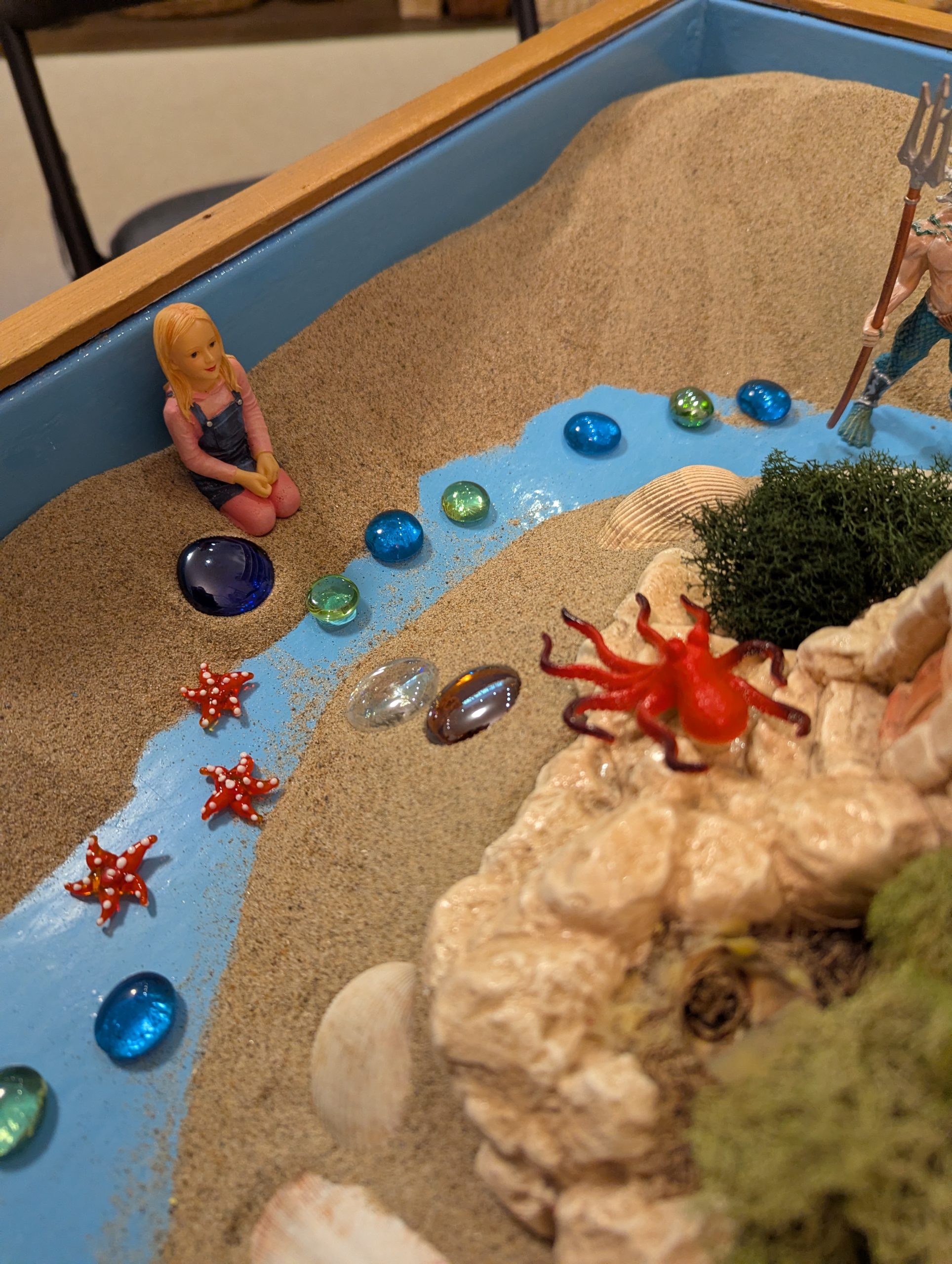
Journeying into Sandplay Therapy Training
It’s been a few days since I have completed Module 1 of Sandplay Therapy with the Canadian Association of Sandplay Therapy in Toronto Canada. Despite all of the training I have invested in as a Registered Psychotherapist, this was my very first in-person training with other psychotherapists. Sandplay is a very niche approach to therapy, and the community in Canada is fairly small. I’ve been trying to reflect on why that is? I think partly it has to do with accessibility to training itself, as part of the requirement of Sandplay Therapy is that it is done in person. The number of in-person hours are mandated by the International Society of Sandplay Therapy (ISST). After now experiencing the in-person experientials firsthand, I understand why. An important part of Sandplay Therapy, is both the ‘free and protected space,’ and the therapist as the witness. There was something that cannot really be put into words, about the experience of working in silence, with other therapists as we work in the sand.
Sand as ‘Prima Materia’
I want to speak a bit more about the material of sand itself. As we learned about the ‘prima materia,’ or ‘primal matter,’ which can be traced to Aristotle, philosophy, and alchemists. Sand can be looked upon as an ancient material, worn down slowly over time. There’s a sense of wholeness, individuation as Jung would refer to it as, or parts, particles, pieces of self or psyche. Sand can symbolize time and passing of time. An obvious example of that being an hourglass with sand smoothly pouring through the narrow chamber in the middle. Sand is fluid, shapeless, flowing, and yet if you add water, another ‘prima materia,’ form can begin to take place. My own associations of sand are also beaches, children and sandcastles, deserts, barren wide-open landscapes, and Egypt, where I once visited that is covered not only in sand, but symbols, ancient practices and meaning. When I traveled through Egypt, I felt most at peace when I was in the desert away from noise and society. I was also startled by the sense of time in Egypt, as the monuments, temples, and symbols I witnessed were so ancient, and as I slept and walked on the desert floor, I would sometimes find shells from a time where the area would have been covered in water. I knew I was part of something much, much bigger than myself.
Reflections
Returning to my questioning of why Sandplay in Canada is such a niche and small community, I also think a part of it is that the collection of figurines and miniatures in the Sandplay room is a reflection of the Sandplay Therapist. The Sandplay collection is not a generalist collection that one purchases, as one may purchase their EMDR equipment in one fell swoop. It’s a collection that is built over time, that the therapist also has their own associations with. Due to this nature, I do not think it works within the group practice setting, as group practices often want to maximize space and return on investment (ROI) with their physical office space, so this means sharing spaces with other therapists who may not practice Sandplay. Also, who’s responsibility does it become to build and maintain the Sandplay collection if one works at a group practice? I have previously brought in my tray and small collection to an office space when I contracted at a group practice, and the office was not a welcoming space to do Sandplay work. The owner encouraged booking back-to-back client sessions (again, ROI), which would allow for no clean up time (as the therapist takes a part the tray in the absence of the client), and the owner sternly instructed to clean up any sand that may escape the box, misunderstanding that the sand is to remain in the sandtray. I cannot foresee a group practice wanting to invest that much space and time into a practice such as Sandplay, unless they were committed to that approach, and thus it becomes a practice that solo practitioners embrace.
Another reflection I had is that the material that the Sandplay Therapist has in their office matters, and so I have now decided that I am on a quest for the most perfect sand for my tray! As I worked with the trainer’s sand, I was drawn to its softness and hints of darker sand pieces compared to my dusty sand and clumps that do not invite my hands into the material. I learned that my trainer spent a lot of time locating, transporting, washing, sifting, baking, and leaving her sand out to dry to achieve the quality that she has. Again, this highlights the importance of the material, because if we do not feel physically called to touch the sand, how are we to be called to drop into our psyche or unconscious? So yes, I have since ordered some new sand, as the Canadian winter is upon us and I may not have enough time to venture to many beaches to seek out the perfect ‘prima materia.’
The Process to Becoming a Jungian Sandplay Therapist
Unlike other trainings in psychotherapy, the process of becoming either a Sandplay Practitioner with CAST, or a Certified Sandplay Therapist with CAST/ISST is a journey itself that involves and inquires the therapist’s own processing. Aligned with Jungian analyst training, the Sandplay Therapist in training is required to do their own processing, meaning creating sand pictures with a Certified Sandplay Therapist over a period of time. The work also requires supervision and consultation with a certified Sandplay Therapist, bringing client work and trays to supervision to analyze and understand the client’s process. Depending on the training stream, there are also symbol papers to write, and as I mentioned previously, hands on experientials with other therapists. It’s not a process that can be done in 6 months, and as a senior Sandplay Therapist in training mentioned during our weekend training, the work informs us; the therapist in training, the person, human being, or Analysand (if we want to be Jungian here). At the moment, I have completed Module 1 and the introductory workshop, bringing it to 34 of the 100 required didactic training hours, with personal process, supervision, and paper writing on the horizon.
My Goals as a Sandplay Therapist in Training
A passion of mine as a psychotherapist is to offer a bridge. Sandplay Therapy is so niche, it’s a rarity in where I live and work, and I want to introduce it and make the process more well known. I want to encourage different ways to work with the mind, body, and psyche. There are enough therapists out there, and in the town of Dundas and city of Hamilton who can provide CBT and DBT skills or even work with EMDR and IFS. I want to create a bridge for people to work with their body, soul, and psyche. For child clients, I want to offer a free and protected space for them to create without direction, without regulation tools and tricks, without more learning and cognitive tools. We forget so often that we are sensory beings. We learn, understand, feel and process with all of our senses. Therapy is not just symptom reduction, assessing and diagnosing. It’s a relational process, and that doesn’t mean just a verbal relationship between the client and therapist. We can support in silence or quiet-the art of witnessing without emoting or offering comments is an energetic support and offering. Therapy can often be looked at as a transaction, monetary speaking, where clients are seeking answers-they want to be told what to do to ‘fix’ their problem, so they can go on in life with more ease. I see this with certain clients who tell me they don’t want to be in therapy for a long time, therapy feels like just talking to a friend, they want skills, ‘tell me what to do,’-yes, part of this may be assessing client-therapist fit, which can be nuanced and sometimes hit or miss, and also it neglects the importance of the therapist alliance, and the client’s responsibility, existentially, for their own progress, curiosity, and ability to be able to sit with the unknown. This may not be how every therapist works and thinks, as we all have our own philosophy and theoretical approach as to how we work. However, I see experiential processing like Sandplay Therapy as deeply enriching, and transformative, especially in the age of AI and virtual world, it’s a practice that requires touch and physical being, presence (with both client and therapist), and being witnessed.
Author
Written by Melissa M White, Registered Psychotherapist and owner of private practice Sojourn Psychotherapy located in Dundas ON, Canada. She uses depth and experiential approaches in psychotherapy, such as attachment focused AF-EMDR, Jungian Sandplay, Sound Therapy, and Dreamwork and Active Imagination. She is currently training to be a Certified Sandplay Therapist with CAST, and works with children and adults in her beautiful office in downtown Dundas ON with Sandplay Therapy.
If you are interested in reaching out for a consultation for psychotherapy or dreamwork, please visit the contact page at https://sojournpsychotherapy.ca or email melissamichellewhite@gmail.com
Website: https://sojournpsychotherapy.ca/
Instagram: https://www.instagram.com/sojourn.psychotherapy/
Psychology Today: https://www.psychologytoday.com/ca/therapists/melissa-white-dundas-on/1100244
Facebook: https://www.facebook.com/profile.php?id=61552257660758
LinkedIn: https://www.linkedin.com/in/melissa-white-m-a-oct-863b3751/

