Carl Jung is well known for his theories of personality that often illustrates the human consciousness and unconsciousness as an ice burg, where the giant unconscious mass of ice submerged underwater acts as the navigator of one’s existence. He believed that when people were born, their Self was whole because they were untouched by influences of parents and society, and they had not yet formed negative beliefs about themselves. As one develops, they learn that in order to assimilate into family and society, that there are certain aspects about themselves that are shameful, undesirable, fearful, and unworthy. Any parts of themselves deemed unacceptable are pushed under water into the unconscious, and they put on a persona, essentially a mask which can be seen as an interface between the Ego, the conscious, and the world (Bolea, 2016). Behind the mask, or persona and one’s Ego, is the shadow and unconscious. The journey to individuation and to Self requires one to accept the shadow and examine their repressed selves, bringing them to light to integrate with their conscious Ego’s.
Masks, Mandala Creation, and Sandplay
Jung was well known for his creative aspirations and focus on individuation in psychoanalysis after separating from Freud, who he felt did not value his beliefs regarding the importance of spiritual and transpersonal aspects of human psyche (Safran et al., 2019). Creatively, Jung inspired many future therapists such as pioneering art therapist Margaret Naumburg (Allen, 2012), and Dora Kalff (1990) to utilize his theories in different modalities, transforming his ideas and supporting the importance of fantasy which he stressed was spontaneous psychic activity (Dehing, 1992). It was early in his career working at a psychiatric hospital that Jung made the observation that the voices and visions that his patients were seeing were not completely random, and that they were aspects of their unconscious, and were a different type of brain processing that involved symbolic narration and meaning (Stagg, 2020). This began his research and studies of the unconscious mind and how it relates to the abstract. Jung produced many works of art in his life, and had a curiosity for images, symbolism, metaphors, and dream analysis. Many people consider him to be the originator of art therapy because he believed in the power of symbolism and considered the artistic process to be alchemic in its approach to individuation (Swann-Foster, 2020). Through the history of famous artworks, such as Frida Kahlo’s The Two Frida’s, or Picasso’s The Tragedy, one can see the fusion between art and soul. Contemporary Jungian art therapists look at their practice as the client having both metaphoric and concrete material to work with, and the symbols created are the modes of expression that initiate the client’s therapeutic development (Granot et. al., 2018).
Masks
Historically mask wearing has provided people with many opportunities, such as tribal and cultural representation, camouflage, fantasy, and empowerment. People wear makeup on a daily basis, scared to show their true skin which they view as undesirable, flawed, or too plain. Warriors and soldiers cover their face, either to hide their fear, make them unseen, or simultaneously illustrating their aggression and mortal threat to others while fearing their own death. Jung views the persona as a symbolic mask, one that people embrace knowing that they may be appealing, appeasing, or even controlling over other people. The persona is not one’s true Self, it’s a mirage that covers up the internal elements of one’s authentic psyche. Art therapists have been embracing the act of mask creation, because it has proved to improve symptoms of anxiety, depression, stress, disassociation, avoidance, hyperarousal, and memory loss, all of which are symptoms of trauma and PTSD (Walker et al., 2017). The largest amounts of studies have been on veterans and active-duty military members who have experienced physical and/or psychological brain injuries that were described as shell shock, combat fatigue, battle exhaustion, or traumatic neurosis during the first and second world wars (Maltz et. al., 2020). Similar to what Jung may have witnessed in the psychiatric hospital, as clients’ re-experiencing, people with trauma and PTSD are living with damaged psyche and split selves.
Mask wearing, in relation to Jungian art theory provides a non-verbal, sensory modality for the client to examine and explore their identity. Ultimately, with longer treatment they can create many masks, digging into their unconscious to see who they really are and what characters they play and identify with in day-to-day life. Like most art therapy, the approach is usually non-directive, giving the clients the opportunity to be uninfluenced in the process. Some examples of masks have shown one’s inner and outer representation of Self, or other dualistic psychological ideas such as public versus private, and night versus day (Walker et al., 2017) through the use of the outer and inner portion of the mask. Recent studies have been showing that talk therapy on its own may not be the most effective approach to trauma and PTSD, because there are other elements to the distress such as body awareness, polyvagal tone, and the need for physical and emotional safety. The goal in art therapy is to provide a safe container for the client to express themselves through sensory and physical tools, rather than verbal expression and reliving the experience. It gives psychological space and safety for expression and externalization (Walker et al., 2017), and allows for the piecing together, dismantling, and rebuilding Self through tactile materials (Swann-Foster, 2020). The process of mask making from a Jungian perspective is viewed as symbolic, because the act of touching the materials is the ignition of physical change and creation, and it is not the end product that is important, it is the experience and the process itself.
Mandala Creation
The expression of the mandala has been around for centuries in many different cultures, traditions, and religions as a symbol of expression, beauty, and universal patterns. They can be seen in jewelry, textiles, nature, traditional aboriginal body art, and have been used as spiritual tools for meditation, healing, and teaching in Buddhist faith. Jung saw mandala creation as a powerful tool to use in a therapeutic setting that provides immediate mental health benefits, improving mood and reducing stress and anxiety (Davis, 2016 as cited by Campenni and Hartmann, 2019). There is an element of mindfulness to mandala creation because it quiets the mind, while allowing various states of consciousness and unconsciousness to travel as one is actively engaged in the flow state. In recent years, popularity of colouring books, including pre-drawn mandalas have been promoted as anti-anxiety, stress relieving activities for people of all ages. However, Jung was particular in his approach and dictated that the unstructured mandala, that should be drawn in a circular formation was preferred over pre-drawn shapes (Campenni & Hartmann, 2019). There have been recent studies assessing and comparing positive affect with drawing within a circular shape or square shape, and results have show specific efficacy for improved state with using a circular boundary for mandala creation (Babouchkina & Robbins, 2015). Art therapists generally prefer that the client designs their own mandala within a circular shape, over the use of premade mandala shapes to be coloured in (Granot et. al., 2018, Babouchkina & Robbins, 2015). While as a basic mindfulness tool, simply colouring in a mandala can initiate mindfulness, and regulation of the nervous system by slowing the breath and easing the mind by reducing rumination and encouraging being in the present moment. However, Jung believed that the use of a symbol acted as a bridge for awareness and individuation (Campenni & Hartman, 2019). This supports the autonomous approach of the client designing their own symbolic mandala which is representative of their psyche (Granot et al., 2018), solving and travelling through one’s own internal labyrinth, which neuropsychology emphasizes the connection and movement of presymbolic, preconscious, and unconscious materials flowing through one’s physical extremities into artistic creation (Swann-Foster, 2020).
Sandplay
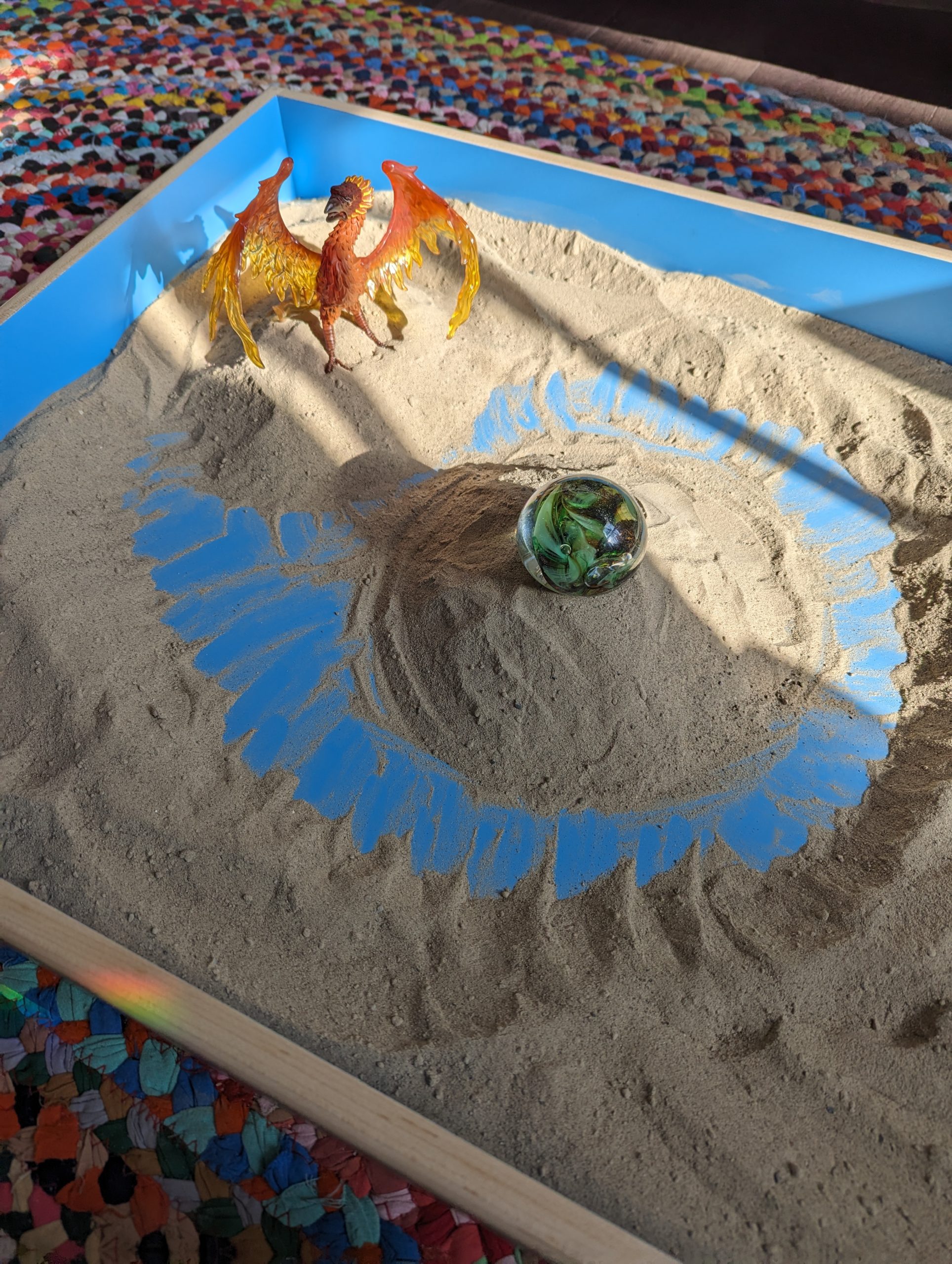
Sandplay Therapy (SPT) was created by Dora Kalff, a Swiss Jungian analyst in the 1950’s, who worked with children and adults using the non-verbal therapeutic medium as a focus on individuation and wholeness. It is an effective tool to use in therapy with people who have language and verbal communication difficulties, disabilities, and trauma. The approach to sandplay includes a wooden tray, approximately 19.5 X 28.5 X 2.75 inches, painted with bright blue water-resistant paint (Kalff, 1990). The boxes are filled with dry and wet sand, and the clients have vast materials at their disposal to choose from to create scenes, stories, fantasies, dreams, or reenactments. The therapist will supply shelves with miniatures, that could include people, houses, animals, bridges, boats, along with natural elements like shells, stones, or bark. With little directive to the client, they can choose their materials and begin to immerse in play, which is the mediator of invisible and visible, conscious, and unconscious, linking the internal and external (Kalff, 1990). It is important that the therapist refrain from interpreting the scene, or comment on emerging symbols as the client is working through their creative and psychological process. Commenting too soon can interrupt internal or unconscious processes and derail or unintentionally promote suggestive answers. Jung viewed the creative process as alchemic, where the client projects their inner unconscious onto the physical materials, raising their conscious to the level he referred to as gold (Granot et al., 2018).
Sandplay with Children and Adults
Sandplay is often associated with children, because of the elements of play. However, it is not exclusively a therapeutic modality for children and youths. They may be more receptive of it, because of the element of play and creation, but it can also be a tool that provides different non-verbal access to an adult’s unconscious thoughts, memories, or shadows. While working with children, art therapists support their creativity and strengthening their Ego, as opposed to working with adults who are middle aged people or older who are seeking individuation and (Granot et al., 2018). It is important that a Jungian art therapist understands developmental stages of children, but also how they relate to Jung’s theories. He believed that when people were born, their Ego was merged with the Self, but as a child grows and develops with more contact to social influences, the Ego begins to separate or differentiate from the Self (Stagg, 2020). While supporting children during sandplay, Kalff suggests that the therapist should provide multiple options such as games, and creative activities like painting or clay modelling because it can contribute to the continuation of the sandplay process and add different elements of creativity, thinking and feeling (Kalff, 1990).
Trauma, both physical and emotional afflicted injuries have been discovered as disconnections that affect adults and children differently because of their brain development. With the developing brains and neuropathways of children, head injuries, or other types of trauma can hinder either the left side of the brain that processes verbal expression, or coded memories that occur in the right side of the brain (Becker, 2015). Similarly, PTSD and trauma can create difficulties in expression or access to memories in adults, further splitting their Ego and Self, discouraging individuation. The modality of sandplay acts as a bridge or network for one to enter their unconscious, face shadows, and continue their quest of the psyche with the assistance of non-verbal exploration which allows them to tolerate the discomfort of their inner journey (Stagg, 2020). The resistance and self-discipline from the therapist to hold space for the client to explore with no commentary is key to the client’s emotional safety and exploration. For adults, profound healing occurs once the individual has reunited with the central archetype of Self, reconnecting themselves bringing the experience into the conscious and integrating it into their awareness and personality (Stagg, 2020). Like all therapy, transference and countertransference will occur, and the picture or story that has been choreographed and established in the sand will also provide another element of transference that the therapist needs to be keenly aware of. The therapist also needs to consider other acts of non-verbal transference during the session, such as movement, eye contact, physical contact between couples, and the space between people.
Couples and Sandplay
Couples therapy can be an uncomfortable environment for clients to be in, because often sessions are riddled with blame, shame, and projection. Typically, one party wants to elicit change from the other, and stalemates occur when lines of communication are broken. Sandplay offers an alternative communicative space for couples to explore themselves, their partner, and their relationship. Jung has looked at marriage as a third entity, where the individuation process is challenged again, and individuals need space to work on their own shadows while viewing their partner as a separate entity in the relationship (Albert, 2015). The process is similar to individual sandplay sessions, and it is recommended that couples share a tray rather than create separate scenes, however the therapist gives little direction on how they should approach the process. Sharing a tray fosters collaboration, and it also provides ample opportunity for the couple to discover non-verbally how they work together and separately. The non-verbal element can also lessen disputes, and provide visual clarity, with the use of symbolism to express the unconscious knowing. Through the Jungian lens, the sandtray is viewed as an alchemical vessel to hold transformation, awareness, and change, and once the conscious understands the meaning of the images, the transformative developments occur on the conscious and unconscious level (Albert, 2015). There are many things an analyst can assess throughout SPT, such as the client’s reaction to the invitation to create, how they interact with the sand, preferences over wet or dry sand, decision making throughout the process, and how the client relates to the materials, environment, and people (Albert, 2015). Once the sandplay task has been completed, clients are invited to talk about the process, and the therapist may then ask questions or invite inquiry from the client.
Considerations
The non-verbal aspects of mask making, mandala creation, and sandplay may not suit every client, especially in situations where they feel they need more guidance. They may not suit certain types of psychopathological disorders, and more empirical studies need to be done to assess the efficacy in specific DSM classes. In some cases, these approaches are seen as last resorts, and the lack of mainstream awareness of knowledge of technique, theory and efficacy evades further engagement and promotion of these specialized therapeutic modalities. Not every therapist suits these approaches, because there is specialized training, and one needs to have the studio space to offer a variety of materials that go beyond the regular scope of pastels, pencils, and gouache (Granot et al., 2018). It is essential that art therapists have the curiosity and discipline to engage in the same modes of expression as their client, actively engaging in their own therapeutic processes through creative means and sensory exploration. Contemporary art therapists agree that Jungian theory is expressed in a different language, one that is full of metaphors, imagery, and symbolism (Granot et al., 2018). Unlike standard talk therapy, Jungian art therapists need to be well versed in visual language, archetypes, and abstract meaning. From a multicultural lens, Jungian art therapy provides a safe space for autonomy, and lessens countertransference through the non-verbal approach. However, Safran et al. (2019) suggests that therapists who are well versed at self-reflection may feel powerless when they witness systems of power, or on the contrary, if a therapist is inept at analyzing their own privilege or similar qualities they may have in common with clients, they may behave overly critical.
Conclusions
In 1915 Jung emerged from one of his darkest days with the discovery and use of mandala creation, which is now used as a therapeutic technique to hold and regulate affect, or close difficult sessions by allowing the client to sit in safety and silence (Swan-Foster, 2020). He called them the “magic circle,” (Zervas, 2019, p. 179 as cited by Swan-Foster, 2020). In terms of non-verbal therapy approaches, Jung and his influence on art therapy offers existential exploration on meaning, Self, and authenticity. For people who encounter difficulties accessing their memories, or processing their experiences, Jungian art therapy approaches allows for different lines of communication, and integration.
Author
Written by Melissa M White, Registered Psychotherapist and owner of Sojourn Psychotherapy located in Dundas Ontario. Melissa White is a trauma and relational therapist, who focuses on experiential processes such as AF-EMDR, Sound Therapy, Experiential Embodied Dreamwork (currently in training), and Jungian Sandplay. She also helps support post-psychedelic psychotherapy or medicine ceremony integration. If you are interested in reaching out for a consultation, please visit the contact page at https://sojournpsychotherapy.ca or emails melissamichellewhite@gmail.com
Website: https://sojournpsychotherapy.ca/
Instagram: https://www.instagram.com/sojourn.psychotherapy/
Psychology Today: https://www.psychologytoday.com/ca/therapists/melissa-white-dundas-on/1100244
Facebook: https://www.facebook.com/profile.php?id=61552257660758
LinkedIn: https://www.linkedin.com/in/melissa-white-m-a-oct-863b3751/
References
Albert, S.C. (2015). Sandplay therapy with couples within the framework of analytical psychology. Journal of Analytical Psychology, 60 (1), 32-53, https://doi.org/10.1111/1468-5922.12128
Allen, P.B. (2012). Art as enquiry: Towards a research method that holds soul truth. Journal of Applied Arts & Health, 3 (1), 13-20, https://doi.org/10.1386/jaah.3.1.13_1
Babouchkina, A., and Robbins, S.J. (2015). Reducing Negative Mood Through Mandala Creation: A Randomized Controlled Trial. Art Therapy: Journal of the American Art Therapy Association, 32 (1), 34-39, https://doi.org/10.1080/07421656.2015.994428
Becker, C.L.J. (2015). Integrating Art into Group Treatment for Adults With Post-Traumantic Stress Disorder from Childhood Sexual Abuse: A Pilot Study. Art Therapy: Journal of the American Art Therapy Association, 32(4), 190-196, https://doi.org/10.1080/07421656.2015.1091643
Bolea, S. (2016). The persona and the shadow in analytic psychology and existentialist philosophy. Philobiblon: Transylvanian Journal of Multidisciplinary Research in Humanities, 21 (1), 84-94, retrieved from https://web.s.ebscohost.com/ehost/detail/detail?vid=17&sid=bdb5b25a-2ac2-4a66-b281-3676dea8ae95%40redis&bdata=JkF1dGhUeXBlPXNzbw%3d%3d#AN=116509258&db=a9h
Campenni, C.E., and Hartman, A. (2020). The Effects of Completing Mandalas on Mood, Anxiety, and State Mindfulness. Art Therapy: Journal of the American Art Association, 37 (1), 25-33, https://doi.org/10.1080/07421656.2019.1669980
Dehing, J. (1992). The therapist’s interventions in Jungian analysis. Journal of Analytical Psychology, 37, 29-47. Retrieved from https://search-ebscohost-com.libraryservices.yorkvilleu.ca/login.aspx?direct=true&AuthType=url,cookie,ip,uid&db=a9h&AN=12234171
Granot, A., Regev, D. and Snir, S. (2018). Jungian theory and its use in art therapy in the viewpoints of Israeli Jungian art therapists. International Journal of Art Therapy: Inscape, 23 (2), 86-97, https://doi.org/10.1080/17454832.2017.1360371
Kalff, D.M. (1990). Introduction to Sandplay Therapy. Journal of Sandplay Therapy, 1 (1), Retrieved from March 11, 2022, https://kennedypsychotherapy.com
Maltz, B., Hoyt, T., Uomoto, J., and Herodes, M. (2020). A case analysis of service-member trauma processing related to art therapy within a military-intensive outpatient program. Journal of Clinical Psychology, 76 (9), 1575-1590,https://doi.org/10.1002/jclp.22929
Safran, J.D., Kriss, A., and Foley, V.K (2019). Psychodynamic Psychotherapies. In Wedding, D., and Corsini, R. J. (Eds.). Current psychotherapies (11th ed, pp. 21-58). Boston, MA: Cengage Cengage
Stagg, E. (2020). Jungian Sandplay For Adults. Therapy Today, 31 (9), 38-41, Retrieved from March 11, 2022, https://web.p.ebscohost.com/ehost/detail/detail?vid=13&sid=7963885e-e5ee-49fe-bb0a-ef5290dfc17f%40redis&bdata=JkF1dGhUeXBlPXNzbw%3d%3d#AN=149034532&db=pbh
Swan-Foster, N. (2020). C.G. Jung’s Influence on Art Therapy and the Making of the Third. Psychological Perspectives, 63 (1), 67-94, https://doi.org/10.1080/00332925.2020.1739467
Walker, M.W., Kaimal, G., Gonzaga, A.M.L, Myers-Coffman, K.A., and DeGraba, T.J. (2017). Active-duty military service members’ visual representations of PTSD and TBI in masks. International Journal of Qualitative Studies in Health and Well-Being, 12(1), 1-12, https://doi.org/10.1080/17482631.2016.1267317

